Concepts are Human, Experience is the world of the Dog
Humans live in concepts.
We retrieve symbols like language, math, and time from long‑term memory.
We recombine them in working memory to calculate, imagine, and project futures.
We can store and recall declarative facts: the capital of France is Paris, 7×8=56, gravity pulls objects down.
We even build artifacts—clocks and calendars—to measure the behavior of the universe we call time.
Dog’s Live in a World of Anticipated Episodes
Dogs live in context.
They don’t stack associations the way we do.
Their memory is anchored to place, tone, smell, and emotional state.
They cannot access declarative facts—no dog will ever “know” that Paris is the capital of France.
Their sense of time is circadian, routine, and sensory—they feel it in fading scents, shifting light, and the rhythm of daily patterns.
Explanation for the Dog’s Anticipation or expected Episodes
And yet—dogs can still anticipate.
They project into the future, not with abstract concepts, but with contextual signals.
We call these factors episodic‑like memory: if X happens now, Y will follow. That’s their version of foresight.
Observing this behavior is why it’s easy to misunderstand their memory as merely “associative.” But the real distinction isn’t whether memory is associative—all memory is associative in humans and dogs alike—the distinction is what kind of associations are possible.
Humans can associate across abstract concepts; dogs associate within lived context.
Humans think in concepts and facts.
Dogs live in context and signals.
All memory is associative—but the scope of association differs.
Humans build artifacts (clocks, calendars) to measure time; dogs sense time through rhythms and cues.
Training fails when we demand human‑style association.
Training succeeds when we weaponize context as the bridge.
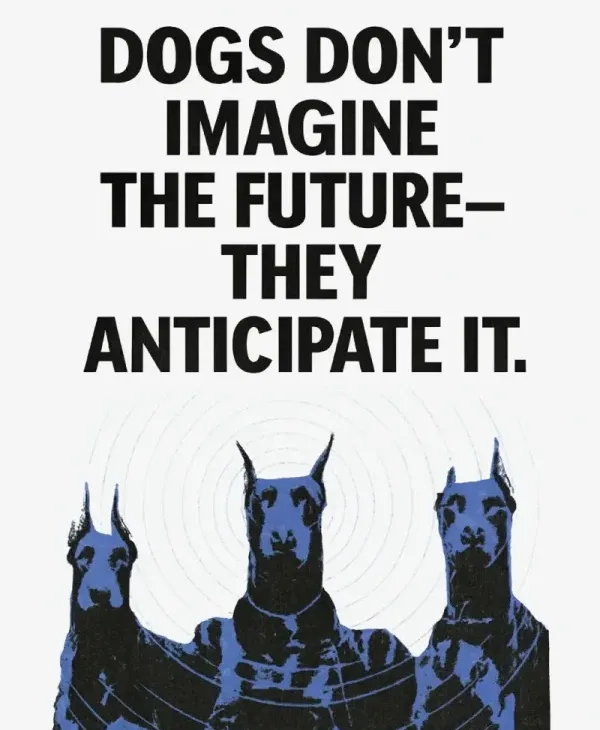
Motto:“Dogs don’t imagine the future—they anticipate it.”
Concepts are Human, Experience is the world of the Dog
Humans live in concepts.
Dog’s Live in a World of Anticipated Episodes
Dogs live in context.
Explanation for the Dog’s Anticipation or expected Episodes
And yet—dogs can still anticipate.
Motto: “Dogs don’t imagine the future—they anticipate it.”
Other Motley Dog articles on Canine Memory
For More on Canine Memory
Memory Spectrum Plate: Human vs. Canine
Learn what Motley's EMDR for dogs can do for you
">EMail
Call