Tier One Dog training
We Offer Private Basic Dog Obedience Training
We are developing an online and/or in person dog training options for our teams.
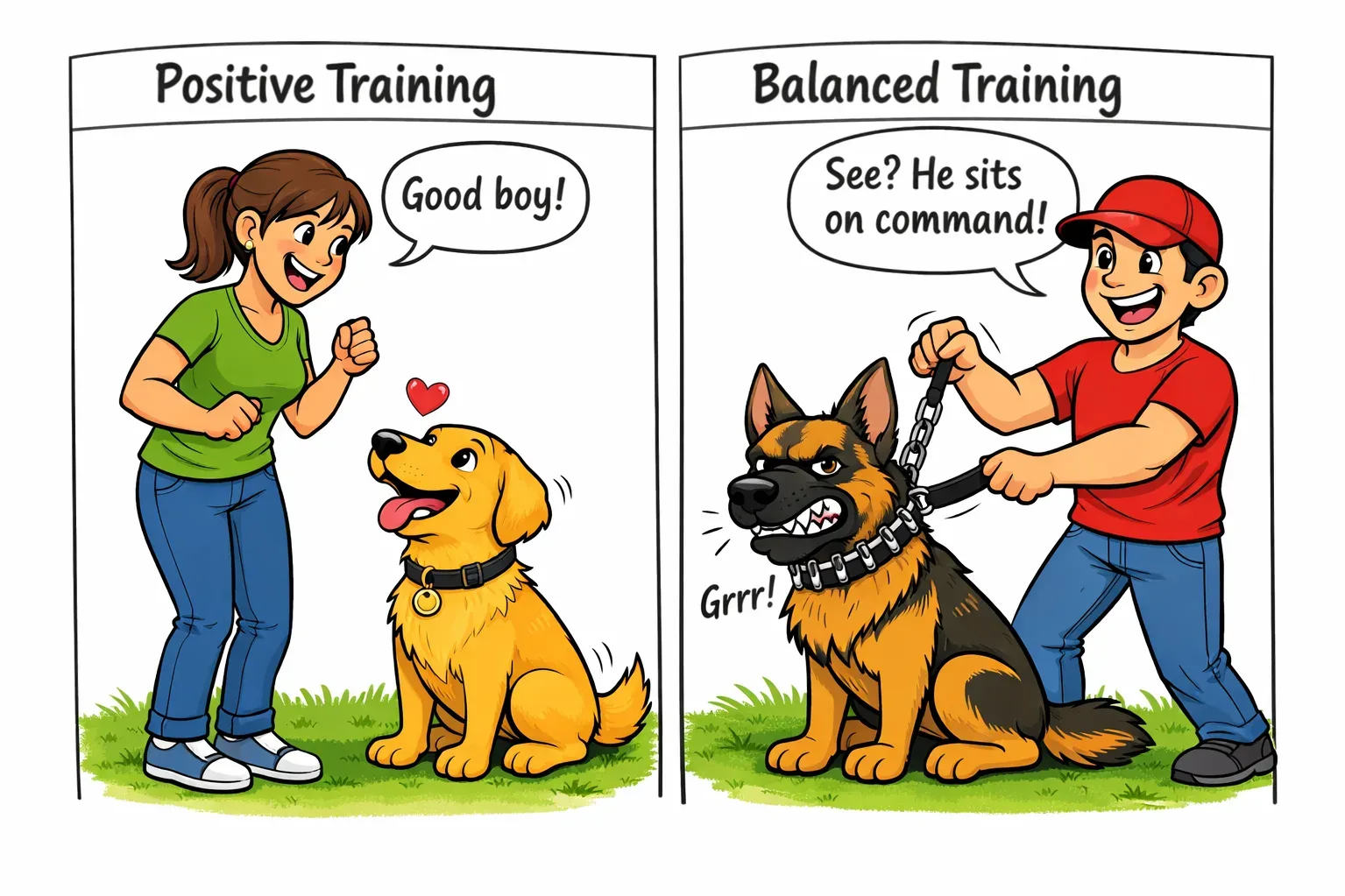
Thoughts
Most people don’t care about trainer red flags until they’ve already been burned. That’s just the reality of this industry. Even if, for some unknown reason, you do not choose Motley Dog Training, we want you to know the red flags we run into daily.
We are often the ones who have to clean up the aftermath created by “dog behavior experts.” The damage is real: confused dogs, stressed owners, bad habits reinforced, fear increased, aggression escalated. We see it every week.
Our goal here is simple — to inform you so you and your dog don’t have to go through that.
[[READ MORE}}
What most of you think about dogs’ cognitive abilities has only started expanding in the last few years. But most people—including many veterinarians—still see canines as simple association‑seeking beasts. So: keep it simple, right?
Canine cognition does not function like yours does.
The dimensions of human cognition are solid. We are the ones who begin with objects, then shapes or patterns.
Dogs do not.
They function in a world of motion, multisensory measures that result in episodes—yes, just like episodes of your favorite TV show. There is nothing human about it.
Motley (2020) copy rite Motley Dog Training LLC
Dog Trainer Selection Red Flags
Just like you, I see lists like these every day. I’m only flagging the ones that actually matter — the ones I wish every dog owner understood.
1. Do they have business insurance?
This shows responsibility and leadership. It matters more than how many certificates they plaster on their site. Insurance means they take their work seriously and they’re accountable for the outcomes.
2. Speaking of certificates — do they actually answer your question, or do they drown you in jargon?
Simple is intelligent. We mean that.
We do not care if you understand the difference between a “positive punishment” and a “negative reward.”
Yes, those are real terms. No, you shouldn’t have to decode them.
If a trainer can’t explain their method in plain language, they don’t understand it well enough to use it.
3. Do they blame you or the dog when their technique doesn’t work?
This is a cover.
It means they only have one solution and they’re trying to protect it.
If the dog doesn’t respond, they blame the handler. If the handler does everything right, they blame the dog.
Blame is a red flag.
It means the trainer has no adaptive model.
4. All dog training — no matter how elaborate the certificate program — is based on one theory of behavior.
Did you know that?
Most people don’t.
I do, because I’ve been through many of them.
If a trainer can only operate inside that single theory, they will misread your dog the moment your dog steps outside the script.
Still think your trainer is the most qualified?
Ask them to set up a short session with you.
These are the behavior you are looking for!
#1 failure point in the industry. If they won’t take the leash, they can’t read thresholds, pressure, or internal state.
If you are there for Obedience this behavior is not acceptable. Actaul behavioral experts have handled hunderds of dogs. If your dog is aggressive pay attention to the dog trainers appoach when you first meet. Do they walk right up to you as if they are saying hello to you? The canine behavior eliet focus on their movement and communication between them and the dog, you are secondary. Not grabing the leash before getting to know the behavior of the dog is the sign of a pro. However, it is the explaination that is telling. If they never intend to handle the dog you are done with your test. Your dog is fearful. Well a dog professional will know how to approach, and they will explain that meeting right now is their choice. If they give you the treat from a stranger theory, I would say your test is over, they fail. Check the acctual findings of this popular theory.
Notice what I am teaching you is what actual eliet behavoral scientists know and that is the story never matters. That is correct we are intentionally not listening to jargon, ratinalizations or well Jerry the greatest dog trainer who ever lived told me this. Name droping is a true sign that someone does not have the real world applied experience to make their own decision in the field when Jerry’s well know theory fails. It will, behavor is not changed by techniques. Have you every tried to change your own behavior? We have all been there. While we are focused we get some change but, when time passes we revert right back to who we are. Dogs are not different and the results of dog training tools, equipment, collars and supliments got managed by a qualified Veterinarian give you the same transient results.
Instead of giving you the typical Dog Trainer Selection Red Flag list I gave you something more valuable. I thought you how to measure the performance of your favorite dog trainer. Do not tell them what you are doing, just do it.
Now just a pro tip. You do not want to be one of those people that show up to a free intro session with a list of dog training questions. I get that free dog training advice is what you are after and all dog trainers do. You will get what you pay for. If this is the hook, make sure they leave the studio with your dog. Some of us cannot handle dogs in the real world so, this is the next test. Misakes, happen all the time and like I said techniques fail. Those of us that have handled hundereds of dogs excpect this we do not avoid it. This is actually were we find out if this is the correct course for you and your dog or if we need to shift to a more suitable tool. These rules and test can not be used if you only train at your home, their studio or my favorite bord and train. Simply, you can never learn to drive a car unless you actually practice driving.
The Stats on Dog Training Methods
From 2005 to 2024, independent behavioral scientists and veterinary‑behavioral departments across North America and Europe conducted long‑term studies examining how different reinforcement structures influence learning stability, retention, and relapse. Motley Dog Training LLC synthesized these findings to help owners understand how method choice directly affects behavioral outcomes.
Across this twenty‑year dataset, balanced reinforcement systems—those combining reward with corrective pressure—showed a 20–35% higher likelihood of behavioral relapse or regression. Subjects often displayed quick initial compliance, but their behavior proved less stable when stress increased or when the guiding human was absent. This reflects a core behavioral‑science principle: when reinforcement becomes inconsistent or aversive, learned behavior becomes fragile.
In contrast, positive reinforcement systems—which maintain clear feedback and preserve the subject’s ability to accurately interpret the environment—demonstrated up to 30% greater long‑term stability and retention. These subjects generalized their learning more reliably across contexts and showed significantly lower rates of regression. Behavioral science consistently shows that clarity and continuity of reinforcement produce durable behavioral change.
This is why Tier One Online Training is built on measurement‑preserving behavioral science, not correction‑based compliance. The method isn’t just kinder — it is measurably more stable.
Clearly this means that all current dog obedience tequniques that are based on rewards:
Are slower but the behavior sticks
Other methods do not correct behavior they surpress it.
This seems great in the present but does not last.
Motley theory 2013 copy righted,
Canine Cognition and Dimensional Sensory Model:
Your dog does not communicate like humans. Human communication is based on one sense and one association not your dogs. A word have meaning to a human and word with not correlating movement has little meaning if any to a dog. Dogs are multidimentional sensory mecheans. Thy requires episodes of sound, motion, smell and harmonics to tie a behavior to a context. This is why repition is so exausting. We do not focus on repitition.
Dog training is the only field that still teaches one theory as if it applies to every dog. MDT does not.
Unlike most dog trainers we do not just offer you a system. I am currently develping the MDT Teir One Dog Training System right below. This is just one of the tools we have to offer for dogs. Just as in human health, your doctors relie on other professionals like our brave Veterianrians and Vet techs, some of which are as good as any vet I have known. We are simlpy giving our team members a foundational tool. Reseach across dog training, Verterinarian medicine, clinical psychology as well as, sport training support a single applied behavoral philosophy. Multipule tools and techniques used together get far better and more importantly, lasting behavioral changes. Dog training offers you one system, one veiw point and still it is based on one theory. We are not.
Welcome to Motley Dog Trainings
Teir One Online Dog Training Courses
Free while in development.
T1 Basic Skill: The Environment Matters
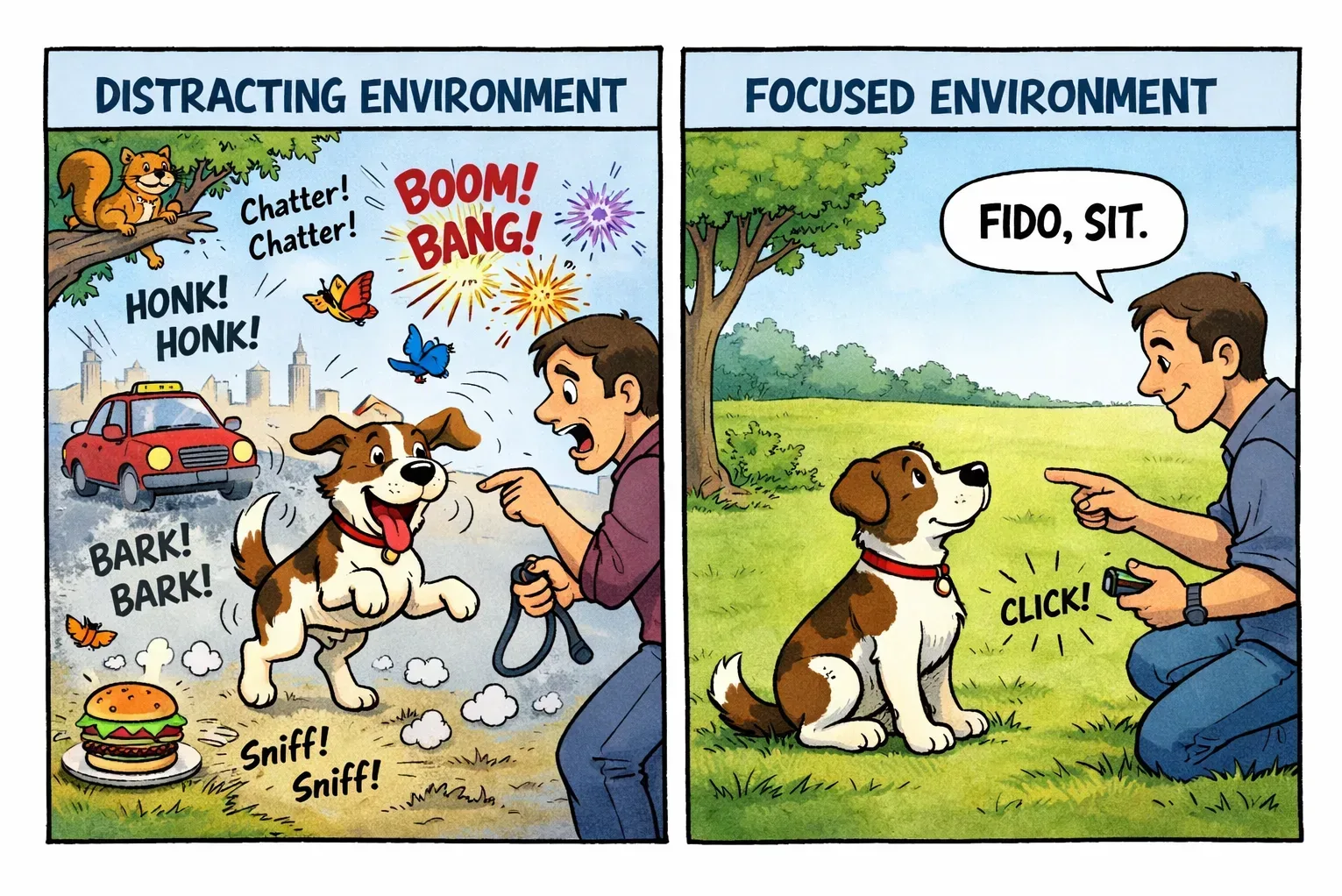
Dogs misbehave in certain places for the same reason humans do — behavior is framed by the environment.
Patterns, habits, and reactions are not floating in space; they are anchored to the physical and social context the dog is standing in.
When you change the dog’s environment, you change the dog’s behavior.
A dog that struggles in one location may perform perfectly in another because the Canine sensory signals are different:
K9 senses are dimensional and dynamic ours are not. The way you see the world in dimension is how all K9 sense work. All other human sense are linear:
Think about it?
One touch
One taste
One smell
Dogs do not function this way.
Obviously this is not what dog trainers tell you.
Dog training technics of both sides of the positive and balanced equation agree that:
A dogs ability to pay attention is based on distractions. There solution more repatition in a distraction free envrionment.
Our solution not only develops canine sensory coordiation between sound signals and movement but, helps the canine transfer skills across environments.
One of our homework assignments that solves two of the most commony questions in dog training.
Tier One training begins with recognizing that behavior is not isolated. It is always shaped by the environment. Before you ask a dog to change, you must first change the environment the behavior is living in.
In Practice
1. Do not walk your dog in the same places all the time.
Repeating the same route strengthens the environmental frame that holds the dog’s bad habits. Changing locations loosens that frame and makes new behavior possible.
2. If there are no distinctions in the environment, your dog decides — not you.
Dogs need clear environmental differences to understand that the rules have changed. Without distinctions, the dog defaults to its own choices.
3. Do not have your heart set on training a specific behavior.
If you can’t get your dog to sit, let it go. Work on what the dog can give you in that moment. Forcing a behavior inside the wrong environment only strengthens resistance.
4. If you can’t get your dog to do anything, have a good time with them and change locations.
Sometimes the environment is too loaded for training. Enjoy the dog, reset the emotional tone, and move to a new place where the dog can measure again.
This is simple right? All we are asking is that you take your furry friend to as many new locations as possible and see how they behave.
The “distinction” level is up to the dog.
Why, the dog has a better idea of what is around you.
Keep in mind you might not agree with your dog or understand what the distraction is but, that is not on your dog.
Find a place where your dog is comfortable
They will thank you by being able to work with you.
Did you have any problems with this skill?
CAUTION
We are working on it!
Nine More T1 Basic Skills Coming Soon!
T1 Basic Skill: Your Dog Does Not Understand Language
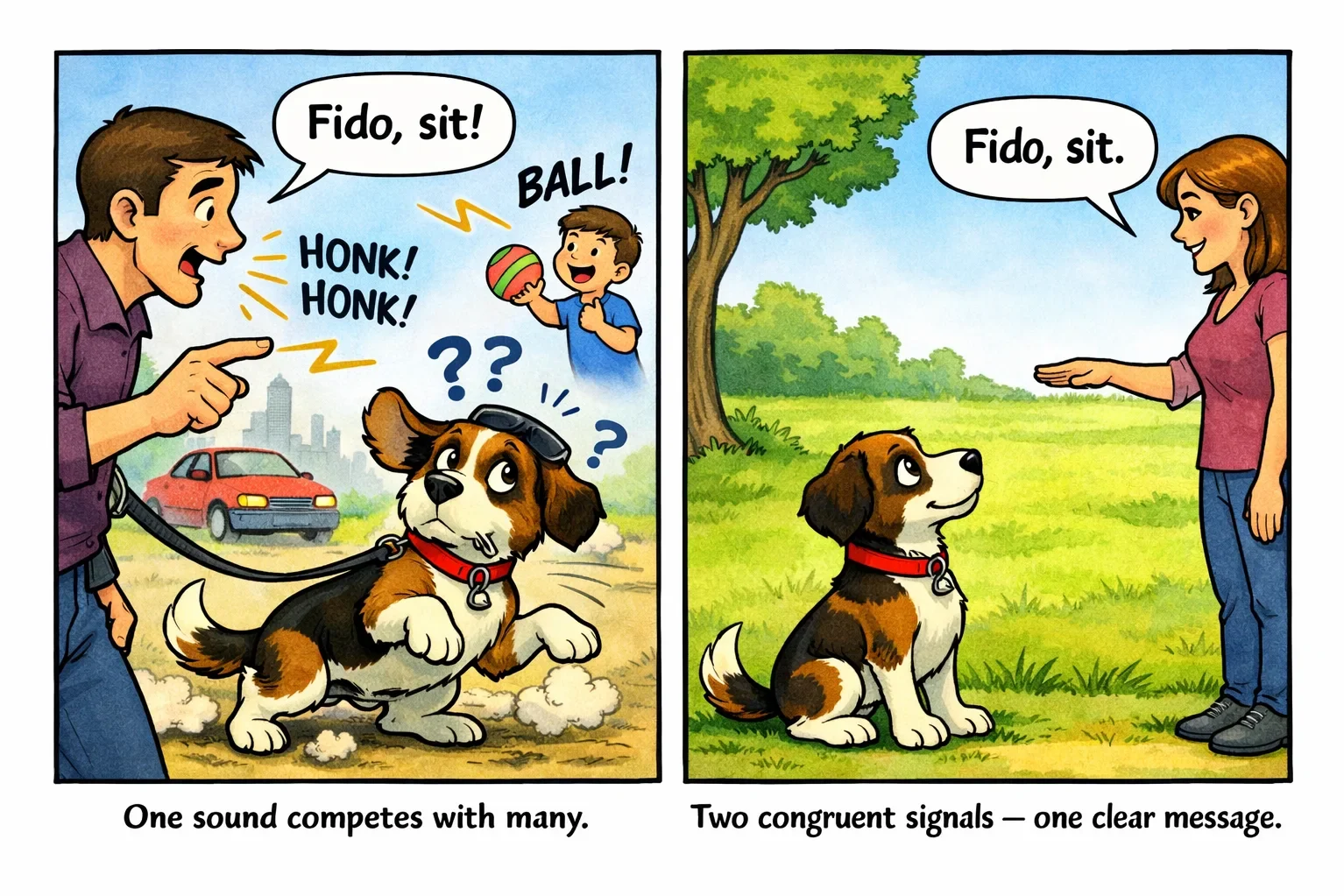
Dogs do not understand English, Spanish, Japanese, or any other human language.
They understand sounds — tone, pitch, duration, rhythm, and emotional charge.
This is why a dog reacts to:
- the rustling in a bush
- a knock at the door
- a TV sound
- a squeak
- a shift in your breathing
- a footstep behind them
Dogs are not “ignoring” your words.
They are processing multiple senses at the same time, and your voice is only one of those inputs.
Humans use one sense at a time and then build a story.
Dogs use many senses at once and build a measurement.
Ever wonder why Military, Police K9’s and Shutzhund uses foreign languages? It is for sound consistancy. The majority of professional working dogs came for other countries that well, train these dog as puppies in their native language. Just as you and I become familar with the timing, tone and variances of our languge dogs become familar with these sound qualities as well. Well follow similar guidelines buy use sound dynamics and motion combined just as dogs do.
They do not learn just the sound but, a dynamic measure of motion and sound that results in their behavioral change. Karon pryor never picked up on the acutal dynamics of Orca but need realize that something worked. What works is a second sound cue that makes the previous sound measure as a higher value.
Motley’s Canine dimensional sensory theory makes it clear that dogs raise the value of sensory measures based on sensory dynamics not pairing. As sound intenstity and amplitude increase in pressure dogs focus on those sounds. Door bells, keys, lightning, and the sounds from your television. They do not measure visually as a secondary or dominate measure like humans but, use their dynamic occular sense to track target and measure distances once a sensore measure alerts.
This has nothing to do with traditional therhold, baseline or trigger theories. These are simple measures better suited for humans and not dogs.
In Practice
1. Stop expecting your dog to understand words.
They understand sound dynamics, not vocabulary.
Your tone matters more than your sentence.
2. Use clear, distinct sounds.
If your commands sound the same, the dog will choose for themselves.
Distinct sounds create distinct behaviors.
3. Don’t get stuck on a specific command.
If the dog won’t sit, stop trying to force the word.
Work with the behavior the dog can give you in that moment.
4. If the dog can’t respond to any sound, reset the environment.
Have a good time with them, lower the emotional load, and move to a new location where their senses can measure again.
Dogs function on groups of signals that result in an action. This is why elite dog trainers tie hand signals to every command. We use this two sensory factor mode ourselves at MDT but expland it to movement as well. If you have ever had your dog look up at you after giving them a well practiced command and go nothing but, the look, they part you need to practice is the movement and non-verbal presentation of your canine communicaion. Dogs know if you are bluffing. They smell it, see it and hearing a familar sound is nothing more than a conformation not a dynamic command.
No, Yelling is not a dynamic command. It translates into barking for most dogs. It is only when your body language and movement coordinate that your dog responds with that,
Oh, Mom is mad at me again look.
You can get that look with movement alone all that barking in not required.