Multi‑Sensory Dimensional EMDR for Dogs (2025–26 Model Advancement)
The title “The new sensory architecture of canines” is deceptive. I am not claiming the discovery of a new sensory array. What I identified are the sensory dimensions and the energy‑system interactions between a dog and its world.
For fifteen years, I ran a longitudinal study examining canine behavior alongside human and cross‑species cognition. The focus was the measurable dimensions of anxiety, depression, and aggression as they appear across species. The core question was simple: How can a species assumed to be fundamentally different from humans produce such consistent behavioral overlap?
It is clear that canines experience the same spectrum of emotion humans do. They even have the same solutions, which are well documented in credible veterinary literature. My work did not deviate from this result but supported it completely. Dogs, like their human counterparts, are susceptible to the same ranges of anxiety, depression, and aggression, as well as the behavioral dimensions that result. This includes inappropriate aggressive behavior, fear that exceeds the context, and the lack of motivation and “caring” seen in typical depression cases.
Further support for my findings is seen in the cross‑species transfer of cognitive‑behavioral techniques such as exposures, shaping, and reframing. Observation and certification training typical of dog trainers gave me a clear indication that these techniques are, in most cases, not well understood or applied correctly in canine behavior cases. Even so, they still serve as good indications that, despite improper training and application, the success rate is statistically significant when compared to other means of dog behavior modification and mirrors human results.
Overall & Dunham (2008), Clinical Behavioral Medicine for Small Animals, document exposure‑based desensitization and counterconditioning as effective and statistically significant for canine fear, reactivity, and aggression.
Range, Virányi & Huber (2007), Current Biology, demonstrate human‑parallel learning patterns in dogs during social and cognitive tasks, confirming cross‑species transfer of learning mechanisms.
Building on this, I expanded the application of CBT into the researched EMDR technique used for human spectrums of trauma that result in dimensions of aggression, anxiety, and depression. This is also consistent in dogs; military working dogs, police K9s, and personal pets have all been documented as exhibiting the same signs of trauma as humans.
After conducting a favorable pilot test, I wrote my first blog post, EMDR for Dogs: The New Science. It was later used as the foundation for an EU research study on the efficacy of applying EMDR to dogs.
Brill On the applicability of eye movement desensitization and … – Brill Sep 28, 2021 · EMDR is a non‑invasive and non‑pharmacological intervention involving bilateral sensory stimulation while memorizing the traumatic event, resulting in decreased emotionality of the memory.
After the initial success of the MDTS EMDR for Dogs program, I remained concerned about its applicability to dogs. More importantly, I still needed an answer—not to why dogs are different from humans, but to the real question: are they actually as different in biological function as psychology teaches?
I developed a high‑stress test protocol using an AI system to check my theories, modeling, and predictions against known sources across several scientific domains, and the findings astounded even me. The results of this year‑long AI stress test form the foundation of my first book, Last in Evolution, released soon. These findings require me to alter the architecture of my EMDR‑for‑dogs application. The premise of human EMDR assumes that altering sensory input across hemispheres produces a REM‑like correlate across species, but this is false. The canine sensory system is dimensional, whereas the human sensory system is flat.
Species Comparison
Dog — Dimensional, multi‑channel Eyes ⇢ ⇢ ⇢ multiple gradient lines Ears ⇢ ⇢ ⇢ multiple frequency bands Nose ⇢ ⇢ ⇢ layered scent vectors Skin ⇢ ⇢ ⇢ multi‑point tactile pulses Body ⇢ ⇢ ⇢ proprioceptive feedback loops
Interpretation: Each sense receives multiple simultaneous inputs, forming dynamic sensory dimensions or event horizon
Human — Linear, single‑channel Eye → one line Ear → one line Nose → one line Skin → one line Tongue → one line
Interpretation: Each sense operates through a single dominant input line, forming a flat sensory event plane.
This means that the results of exposures using bilateral stimulation of a single sense in humans cannot be transferred to dogs. Sleep studies indicate that canine sleep is different from human sleep, and this produces a sensory bias toward movement. Movement, for a dog, is not a single‑line event as it is for humans. A sound is not a simple harmonic frequency organization like it is for a human. Canine senses are based on short, fast waves and gradients. Regardless of theoretical perspective on perception or sensory sampling, the sensory dynamics do not fit.
For a dog, watching a single stimulus move horizontally across its visual event horizon is nothing more than business as usual. Similarly, alternating touches or sounds produce the same “as always” effect for canines. The results reflect the dynamics already established in traditional forms of exposure therapy in dogs, not the bilateral intervention I was aiming for.
Sleep Architecture Evidence
Bódizs, Kis, Gácsi & Topál (2020), Sleep in the dog: comparative, behavioral and translational relevance, Current Opinion in Behavioral Sciences, 33, 25–33, show that dogs exhibit polyphasic sleep, different proportions of REM and slow‑wave sleep, and greater sleep fragmentation compared to humans.
Canine Sleep Architecture: REM Cycles, Sleep Disorders, and Cognitive Research (2026) Dogs sleep 12–14 hours per day, distributed across multiple bouts (polyphasic), unlike humans who consolidate sleep into one long nocturnal period. Dogs spend more time in slow‑wave sleep (SWS) and have different REM cycle timing than humans.
Current research indicates that dog sleep is fragmented, focused on SWS and not REM like humans. This means that the state I attempted to emulate has very different dimensions than those found in humans. The physiological and biological conditions of SMS must be established, and slow multisensory stimulation applied.
Key findings that match my claim:
Dogs are polyphasic sleepers (many short bouts), unlike humans who are monophasic.
Canine sleep is more fragmented than human sleep.
Dogs spend more time in slow‑wave sleep (SWS) relative to humans.
Dogs show different REM proportions and timing than humans.
Sleep architecture in dogs is not homologous to human REM‑dominant emotional processing.
State, Sensory Dimensions, and Intervention
Each sensory application must be established before therapy can commence.
Once sensory manipulation is acquired, the focus becomes state. After state is practiced and maintained, the sensory dimensions of the context can be applied, and the controllables—not the event in the context—become the target of intervention.
Amygdala Dynamics
“This intervention in theory will alter the dimensions of the sensory dynamics the dog experiences and reduces amygdala wave expansion,” as supported by:
Panksepp, J. (1998), Affective Neuroscience: The Foundations of Human and Animal Emotions, Oxford University Press.
Key findings that support my claim:
The amygdala is the primary generator of fear‑based arousal in mammals, including dogs.
Sensory input (especially tactile, auditory, and movement‑based cues) can modulate amygdala activation.
Controlled sensory stimulation can reduce arousal waves in the amygdala and shift the animal into a lower‑threat processing mode.
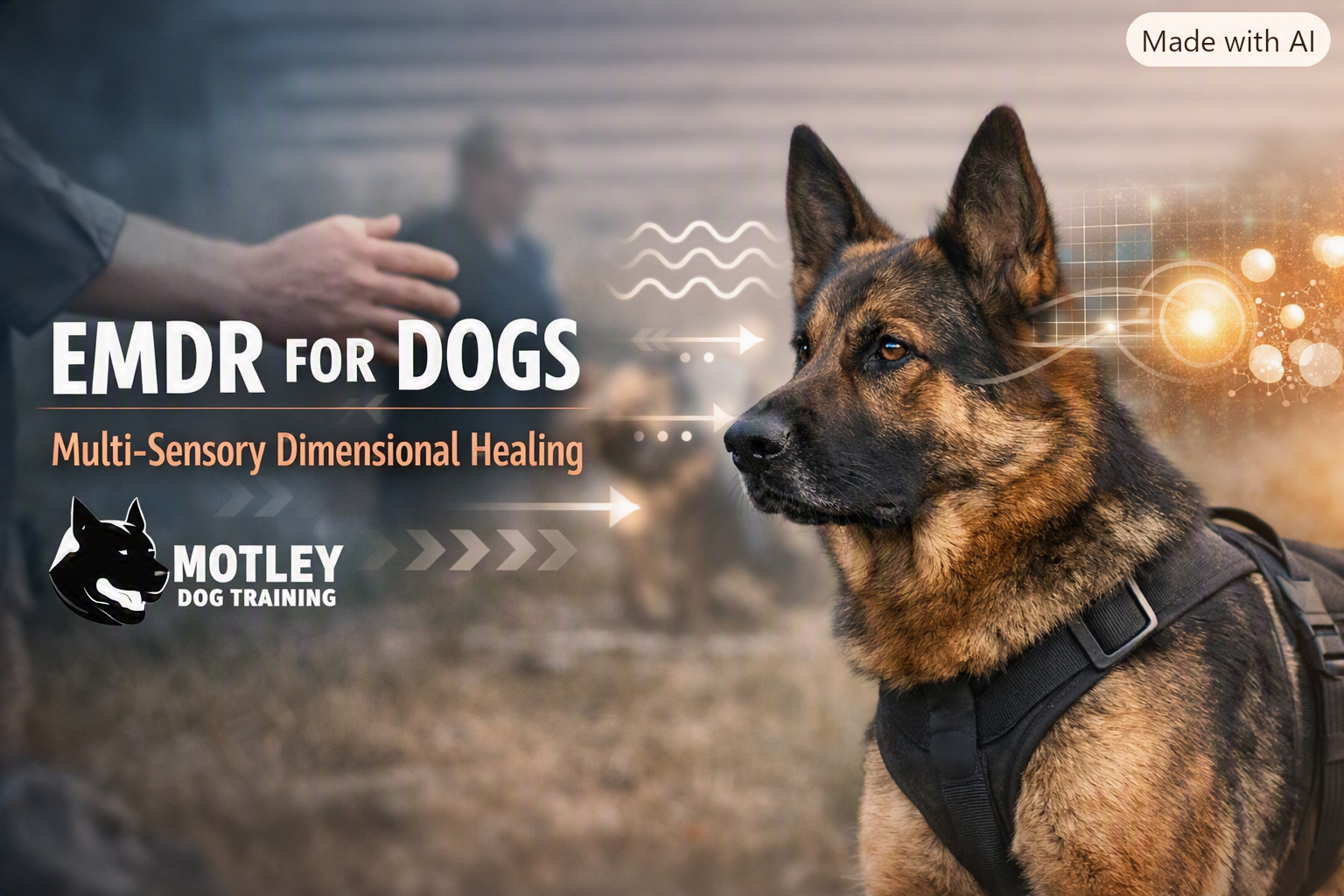
The New Sensory Architecture of Canines
Multi‑Sensory Dimensional EMDR for Dogs (2025–26 Model Advancement)
The title “The new sensory architecture of canines” is deceptive. I am not claiming the discovery of a new sensory array. What I identified are the sensory dimensions and the energy‑system interactions between a dog and its world.
For fifteen years, I ran a longitudinal study examining canine behavior alongside human and cross‑species cognition. The focus was the measurable dimensions of anxiety, depression, and aggression as they appear across species. The core question was simple: How can a species assumed to be fundamentally different from humans produce such consistent behavioral overlap?
It is clear that canines experience the same spectrum of emotion humans do. They even have the same solutions, which are well documented in credible veterinary literature. My work did not deviate from this result but supported it completely. Dogs, like their human counterparts, are susceptible to the same ranges of anxiety, depression, and aggression, as well as the behavioral dimensions that result. This includes inappropriate aggressive behavior, fear that exceeds the context, and the lack of motivation and “caring” seen in typical depression cases.
Further support for my findings is seen in the cross‑species transfer of cognitive‑behavioral techniques such as exposures, shaping, and reframing. Observation and certification training typical of dog trainers gave me a clear indication that these techniques are, in most cases, not well understood or applied correctly in canine behavior cases. Even so, they still serve as good indications that, despite improper training and application, the success rate is statistically significant when compared to other means of dog behavior modification and mirrors human results.
Overall & Dunham (2008), Clinical Behavioral Medicine for Small Animals, document exposure‑based desensitization and counterconditioning as effective and statistically significant for canine fear, reactivity, and aggression.
Range, Virányi & Huber (2007), Current Biology, demonstrate human‑parallel learning patterns in dogs during social and cognitive tasks, confirming cross‑species transfer of learning mechanisms.
Building on this, I expanded the application of CBT into the researched EMDR technique used for human spectrums of trauma that result in dimensions of aggression, anxiety, and depression. This is also consistent in dogs; military working dogs, police K9s, and personal pets have all been documented as exhibiting the same signs of trauma as humans.
After conducting a favorable pilot test, I wrote my first blog post, EMDR for Dogs: The New Science. It was later used as the foundation for an EU research study on the efficacy of applying EMDR to dogs.
Brill On the applicability of eye movement desensitization and … – Brill Sep 28, 2021 · EMDR is a non‑invasive and non‑pharmacological intervention involving bilateral sensory stimulation while memorizing the traumatic event, resulting in decreased emotionality of the memory.
After the initial success of the MDTS EMDR for Dogs program, I remained concerned about its applicability to dogs. More importantly, I still needed an answer—not to why dogs are different from humans, but to the real question: are they actually as different in biological function as psychology teaches?
I developed a high‑stress test protocol using an AI system to check my theories, modeling, and predictions against known sources across several scientific domains, and the findings astounded even me. The results of this year‑long AI stress test form the foundation of my first book, Last in Evolution, released soon. These findings require me to alter the architecture of my EMDR‑for‑dogs application. The premise of human EMDR assumes that altering sensory input across hemispheres produces a REM‑like correlate across species, but this is false. The canine sensory system is dimensional, whereas the human sensory system is flat.
Species Comparison
Dog — Dimensional, multi‑channel Eyes ⇢ ⇢ ⇢ multiple gradient lines Ears ⇢ ⇢ ⇢ multiple frequency bands Nose ⇢ ⇢ ⇢ layered scent vectors Skin ⇢ ⇢ ⇢ multi‑point tactile pulses Body ⇢ ⇢ ⇢ proprioceptive feedback loops
Interpretation: Each sense receives multiple simultaneous inputs, forming dynamic sensory dimensions or event horizon
Human — Linear, single‑channel Eye → one line Ear → one line Nose → one line Skin → one line Tongue → one line
Interpretation: Each sense operates through a single dominant input line, forming a flat sensory event plane.
This means that the results of exposures using bilateral stimulation of a single sense in humans cannot be transferred to dogs. Sleep studies indicate that canine sleep is different from human sleep, and this produces a sensory bias toward movement. Movement, for a dog, is not a single‑line event as it is for humans. A sound is not a simple harmonic frequency organization like it is for a human. Canine senses are based on short, fast waves and gradients. Regardless of theoretical perspective on perception or sensory sampling, the sensory dynamics do not fit.
For a dog, watching a single stimulus move horizontally across its visual event horizon is nothing more than business as usual. Similarly, alternating touches or sounds produce the same “as always” effect for canines. The results reflect the dynamics already established in traditional forms of exposure therapy in dogs, not the bilateral intervention I was aiming for.
Sleep Architecture Evidence
Bódizs, Kis, Gácsi & Topál (2020), Sleep in the dog: comparative, behavioral and translational relevance, Current Opinion in Behavioral Sciences, 33, 25–33, show that dogs exhibit polyphasic sleep, different proportions of REM and slow‑wave sleep, and greater sleep fragmentation compared to humans.
Canine Sleep Architecture: REM Cycles, Sleep Disorders, and Cognitive Research (2026) Dogs sleep 12–14 hours per day, distributed across multiple bouts (polyphasic), unlike humans who consolidate sleep into one long nocturnal period. Dogs spend more time in slow‑wave sleep (SWS) and have different REM cycle timing than humans.
Current research indicates that dog sleep is fragmented, focused on SWS and not REM like humans. This means that the state I attempted to emulate has very different dimensions than those found in humans. The physiological and biological conditions of SMS must be established, and slow multisensory stimulation applied.
Key findings that match my claim:
Dogs are polyphasic sleepers (many short bouts), unlike humans who are monophasic.
Canine sleep is more fragmented than human sleep.
Dogs spend more time in slow‑wave sleep (SWS) relative to humans.
Dogs show different REM proportions and timing than humans.
Sleep architecture in dogs is not homologous to human REM‑dominant emotional processing.
State, Sensory Dimensions, and Intervention
Each sensory application must be established before therapy can commence.
Once sensory manipulation is acquired, the focus becomes state. After state is practiced and maintained, the sensory dimensions of the context can be applied, and the controllables—not the event in the context—become the target of intervention.
Amygdala Dynamics
“This intervention in theory will alter the dimensions of the sensory dynamics the dog experiences and reduces amygdala wave expansion,” as supported by:
Panksepp, J. (1998), Affective Neuroscience: The Foundations of Human and Animal Emotions, Oxford University Press.
Key findings that support my claim:
The amygdala is the primary generator of fear‑based arousal in mammals, including dogs.
Sensory input (especially tactile, auditory, and movement‑based cues) can modulate amygdala activation.
Controlled sensory stimulation can reduce arousal waves in the amygdala and shift the animal into a lower‑threat processing mode.
Dogs exhibit species‑specific sensory gating, meaning sensory dynamics directly influence emotional wave expansion.
Add Your Heading Text Here
Learn what Motley's EMDR for dogs can do for you
">EMail
Call